Key Trends in the Last 10 Years
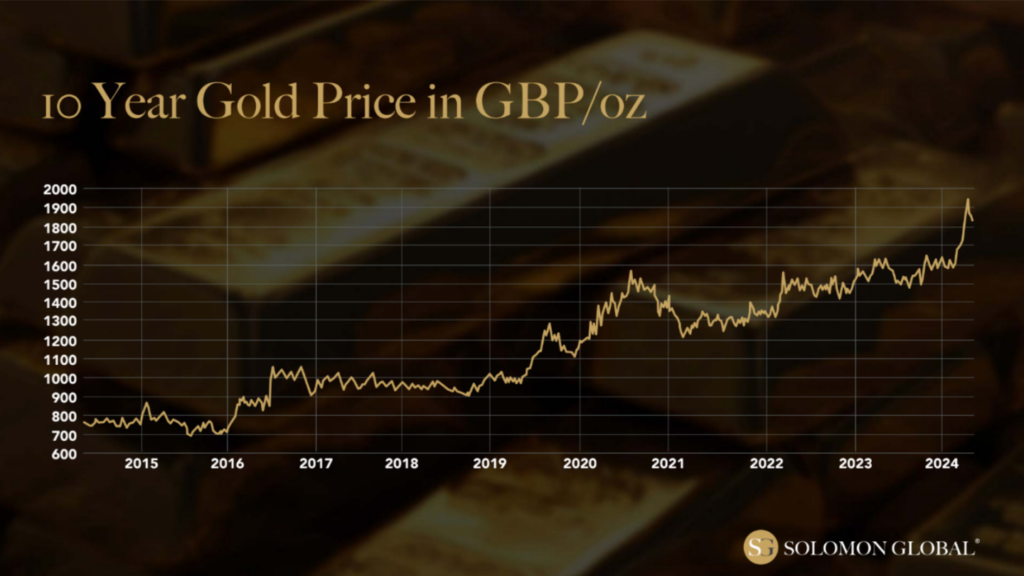
- 2014–2016: Period of Stability From 2014 to 2016, gold prices remained relatively stable, fluctuating between GBP 700 and GBP 900 per ounce. During this time, the global economy was recovering from the aftermath of the 2008 financial crisis, with markets showing moderate growth. Although there were minor price spikes, driven by geopolitical tensions and economic concerns, the overall trend was steady. Gold maintained its role as a stable asset but did not experience significant price growth.
- 2017–2019: Gradual Price Increase The years 2017 to 2019 saw a gradual increase in gold prices, largely driven by escalating geopolitical tensions, uncertainties surrounding global trade (such as the U.S.-China trade war), and concerns over slowing economic growth. Investors began to turn to gold as a safe haven asset amidst these growing concerns. By the end of 2019, gold prices had surpassed GBP 1,000 per ounce, marking a notable shift in investor confidence in the precious metal.
- 2020: A Year of Uncertainty and Price Surge The year 2020 marked a turning point for gold prices, as the COVID-19 pandemic spread across the globe. The unprecedented economic shock and market volatility caused by the pandemic pushed investors to seek safety in gold, driving prices to new heights. By mid-2020, gold prices had surged to over GBP 1,500 per ounce, as central banks implemented stimulus packages and interest rates dropped to historic lows. The flight to safety was evident, as investors sought to protect their portfolios from the uncertainty brought by the pandemic. Gold’s role as a hedge against economic turmoil was on full display, leading to record-breaking prices during this period.
- 2021–2023: Post-Pandemic Stabilisation Following the significant price surge in 2020, gold prices began to stabilise, though they remained well above pre-pandemic levels. In the post-pandemic era, economies around the world worked toward recovery, but ongoing challenges such as inflation, supply chain disruptions, and geopolitical tensions continued to support gold’s high value. During this period, prices fluctuated between GBP 1,200 and GBP 1,500 per ounce, reflecting a balance between economic recovery efforts and continued demand for gold as a safe-haven asset.
- 2024: Record Highs in Gold Prices As of the most recent data in 2024, gold prices are continuing their upward trend, approaching record highs of GBP 1,800–1,900 per ounce. The ongoing challenges of global inflation, rising interest rates, and geopolitical uncertainty have sustained investor interest in gold. The precious metal continues to be viewed as a stable investment option in the face of economic volatility and currency fluctuations.
Why Has Gold Performed Well?
- Safe Haven Asset: Gold’s reputation as a safe haven asset has been a key factor in its price growth over the last decade. In times of economic instability—whether due to global pandemics, political uncertainty, or financial crises—investors turn to gold to preserve their wealth. The COVID-19 pandemic in particular demonstrated how gold can act as a refuge during unpredictable times, pushing its price to new highs.
- Inflation Hedge: Gold is widely recognised as an effective hedge against inflation. During periods of rising inflation, the value of fiat currencies tends to decline, which can erode purchasing power. However, gold generally maintains its value or appreciates in such conditions, making it an attractive option for investors seeking to protect their assets. With inflationary pressures mounting in recent years, the demand for gold has remained strong.
- Currency Fluctuations: The fluctuation of major currencies, including the British pound (GBP), has also played a role in gold’s price performance. As central banks around the world have implemented policies such as quantitative easing and interest rate changes, currency values have fluctuated. Gold, being a globally recognised asset, tends to rise in value when currencies weaken, further contributing to its appeal as a store of value.